On February 18, 2021, the Mars 2020 Perseverance rover landed in Jezero crater. Since then, the seven payload instruments have conducted a detailed scientific investigation of the Martian surface, seeking potential signs of past life.
Since 2021, I’ve been on the science and operations team for the SHERLOC instrument, a deep UV Raman and fluorescence mapping spectrometer that analyzes rocks and regolith at finest scale ever achieved. In this role, I bridge mission, laboratory, and field to define and investigate science questions relevant to astrobiology and planetary science. I’ve led several scientific and technical efforts — from writing one of the first instrument science papers to chairing the mission’s Astrobiology and Geochemistry working group.
I led the second ever paper from the SHERLOC instrument, focusing on fluorescence spectra that we detected in the first 10 rock targets of our first campaign. I discovered multiple patterns spatially associated with Raman spectra signifying a range of minerals. We also identified the first possible Raman spectrum of organic molecules on Mars in a target called Montpezat. I compared the mission data to laboratory spectra, laying out multiple possibilities for the origin of the fluorescence, including organic and inorganic. Follow on work advanced the inorganic hypotheses for some of these fluorescence signals, and possible organic sources for other Raman spectra I first reported from the Crater Floor. Ongoing work is focused on further investigating inorganic hypotheses for fluorescence, and generating a broader understanding of how these spectra and image data are shaping our understanding of Jezero crater and Mars at large.
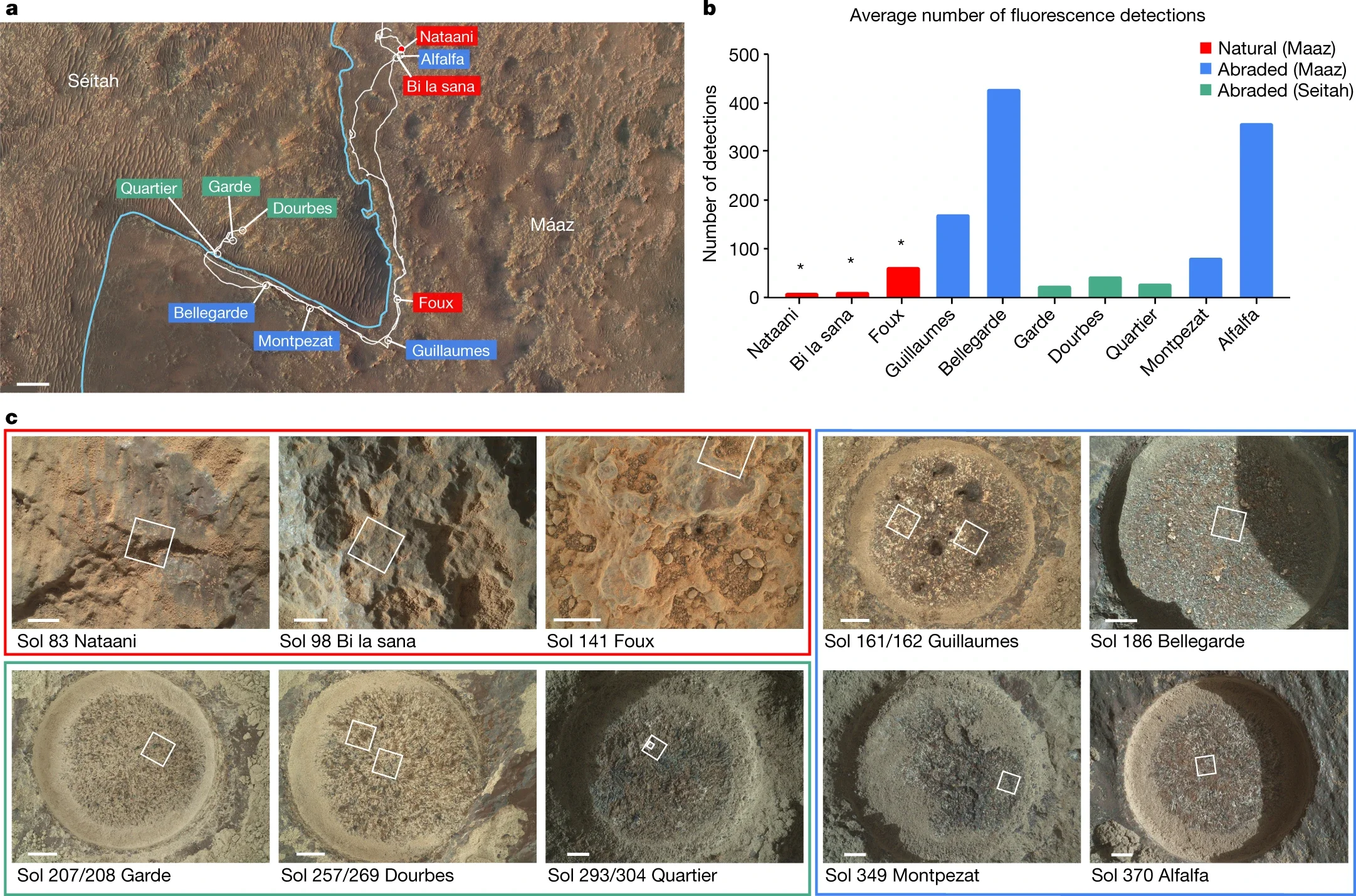
I developed several data and image processing tools that have been adopted by the instrument team, mission science operations, and released as new technologies by JPL. These include notebooks and scripts for calibrating the flight analog instruments, and an automated co-registration and composite generation tool to combine data from two context imagers. Most recently, I developed a database and exploratory tool containing all SHERLOC data from all targets to date, with associated target metadata to enable investigating big-picture science questions.

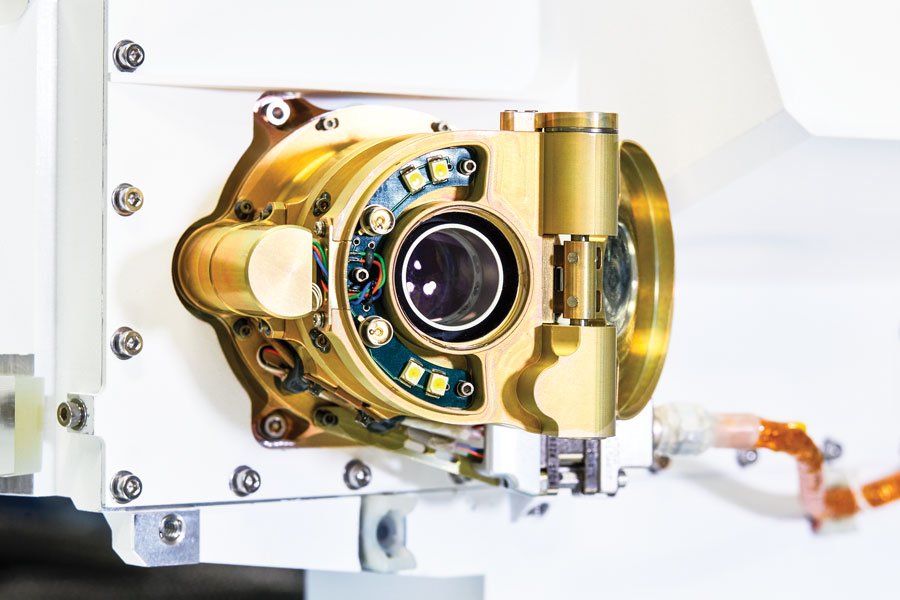
As the main operator of the two SHERLOC analog instruments at the Jet Propulsion Laboratory, I developed manuals for operation and troubleshooting, pipelines for data calibration and processing, and trained postdocs, students, and technologists. I established a standardization procedure, data structure, and organization for the analog data from our instruments and others on the team, which is now hosted on the Open Data Repository. I also contributed to publishing our analog spectral library, focusing on organic standards.
By using one of our flight analog instruments and developing a new set of experiments, I contributed to recovering the SHERLOC instrument back to operational status after it was taken offline. This feat (achieved from ~140 million miles away) was recognized with a NASA Award in 2024 for the SHERLOC Anomaly Recovery Team.